Kitchen Remodeling
Quartz vs Granite Countertops for Colorado Kitchens
By Alex Kissel · August 24, 2026 · 5 min read
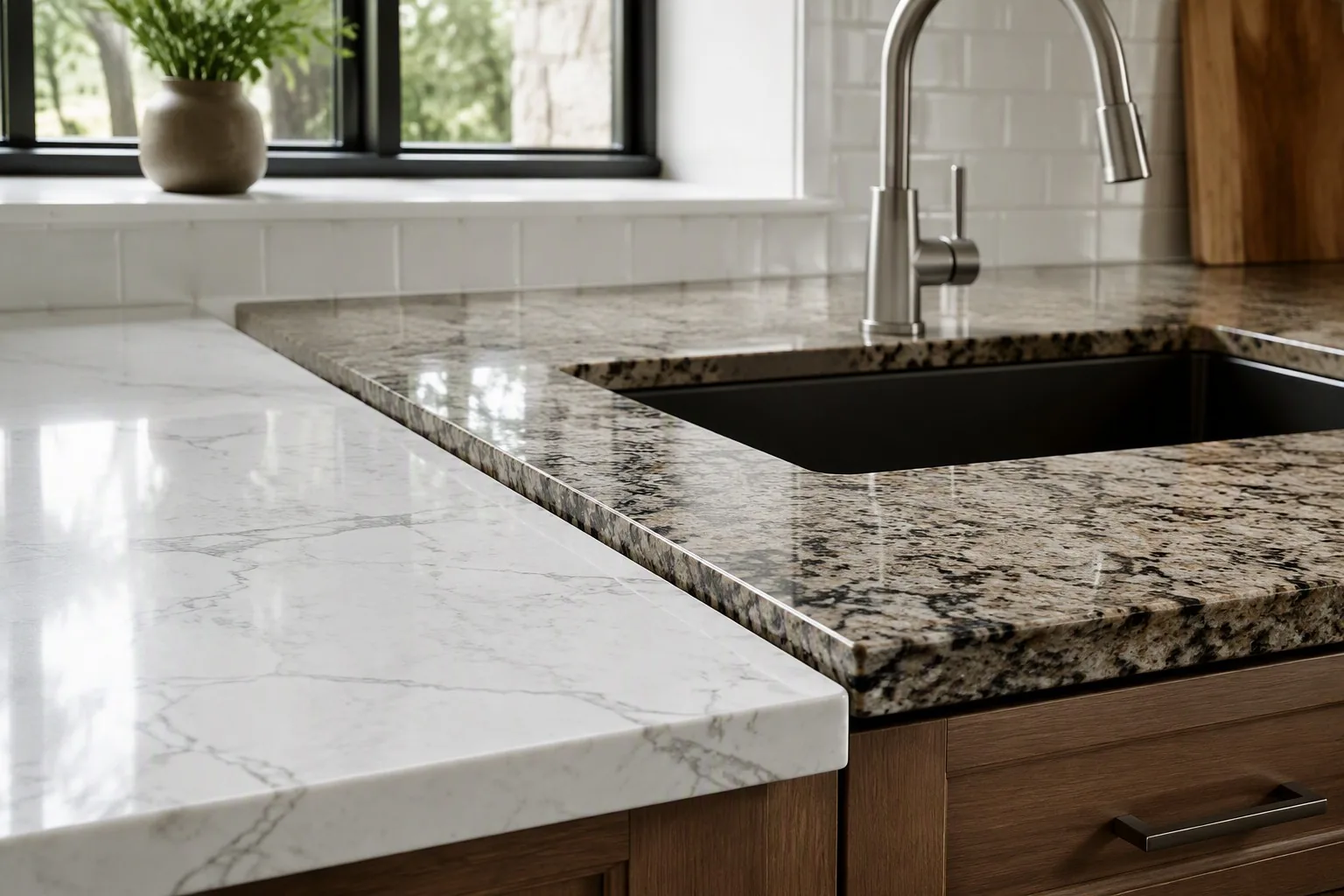
Quartz or granite? It’s the countertop question we hear most from homeowners across Denver, Aurora, and the surrounding suburbs — and there’s no universally right answer. Both are excellent, durable surfaces that perform well in Colorado’s climate. Quartz gives you consistency and near-zero maintenance. Granite gives you natural, one-of-a-kind character and superior heat tolerance. Here’s how to choose based on how you actually live.
The Case for Quartz
Quartz countertops are engineered: roughly 90-plus percent ground natural quartz bound with resins and pigments. That manufacturing process creates some practical advantages:
- Non-porous surface. Nothing soaks in — not wine, not coffee, not cooking oil. It never needs sealing, ever.
- Consistent appearance. What you see in the sample is what you get across the whole slab, which makes planning and seam-matching predictable.
- Low maintenance. Mild soap and water is the entire care routine.
- Huge design range. From solid contemporary colors to patterns that convincingly mimic marble without marble’s fragility.
The trade-offs: quartz is less heat-tolerant than natural stone because the resin binders can scorch, and some patterns can look uniform to the point of feeling manufactured if natural variation is what you love.
The Case for Granite
Granite is quarried natural stone — every slab is geologically unique. Its strengths:
- Heat tolerance. Brief contact with hot cookware won’t damage it the way it can damage quartz.
- Genuine character. No two slabs match. If you want a surface nobody else has, granite delivers.
- Proven longevity. Granite kitchens installed decades ago still look good today with basic care.
- Strong resale recognition. Buyers still read “granite countertops” as a quality signal in listings from Boulder to Highlands Ranch.
The trade-offs: granite is porous and needs periodic sealing — typically every one to three years — and its natural variation means you should select your actual slab in person rather than trusting a small sample.
Quartz vs. Granite at a Glance
| Factor | Quartz | Granite |
|---|---|---|
| Maintenance | Soap and water only | Periodic sealing required |
| Stain resistance | Excellent (non-porous) | Good when properly sealed |
| Heat tolerance | Moderate — use trivets | High |
| Appearance | Consistent, uniform | Unique natural variation |
| Scratch resistance | Very good | Very good |
| Slab selection | Sample is representative | Choose the actual slab |
| Price | Comparable range | Comparable range |
For most Denver kitchens, installed pricing for the two materials overlaps considerably. Material grade, edge profile, and cutouts move the number more than the quartz-versus-granite choice itself. Our countertop replacement service starts at $4,200 with a 1–2 day installation.
Colorado-Specific Considerations
Dry climate and altitude
Here’s the good news: neither material struggles with our low humidity — that’s more of a wood-cabinet concern than a stone one. But our climate does matter in a couple of practical ways. Denver’s intense sun pours through the big south- and west-facing windows common in local homes, and prolonged direct UV exposure can fade or yellow some quartz resins over time. If your counters sit in a sunbeam all afternoon, granite — or a UV-stable quartz line — deserves a hard look.
Hard water
Front Range water is mineral-heavy, and those minerals leave spots and film on every surface near the sink. Neither quartz nor granite will be damaged by hard water, but polished dark surfaces of either type show spots more readily. If you want low-fuss cleanup, lighter colors and honed or matte finishes hide water marks better — a small choice that pays off daily.
Colorado style
Local design taste has been drifting toward warm, nature-inspired palettes: soft whites and creams, warm grays, subtle veining that echoes the foothills rather than competing with them. Both materials offer strong options in that direction. Heavy, high-contrast patterns still work in rustic and mountain-style kitchens, but the busiest granite patterns of the early 2000s are firmly out of fashion — something to consider if resale is on your horizon.
What Countertops Cost in Denver
Countertop replacement starts at $4,200 and takes 1–2 days, making it one of the fastest high-impact upgrades you can make. The variables that move your quote:
- Material tier — entry-level slabs and colors cost less than exotic or premium selections
- Square footage — larger kitchens and islands need more material
- Edge profile — simple eased edges are standard; ogee and waterfall details add cost
- Cutouts — undermount sinks, cooktops, and faucets each add fabrication work
For a full breakdown of pricing across project types, see our countertop replacement cost guide and our Denver kitchen remodel cost guide.
So Which Should You Choose?
A simple decision framework:
- Choose quartz if you want zero maintenance, consistent color, a contemporary look, or you have kids who treat counters as a science lab.
- Choose granite if you love natural stone character, cook aggressively with hot pans, have strong sun exposure on your counters, or want the confidence of selecting a one-of-a-kind slab.
- When in doubt, visit a slab yard. Standing in front of full slabs settles this question faster than any article — including this one.
Whatever you choose, installation quality matters as much as material. Precise templating, level installation, and clean seam work are what separate counters you love from counters you tolerate. Kissel’s Bath and Kitchen is a family-owned, licensed and insured general contractor based in Aurora, with 200+ completed projects, a 4.9-star Google rating from 40 reviews, and a 1-year labor warranty on our work. Every project comes with fixed, itemized pricing and a free in-home estimate.
See our countertop and kitchen services for current starting prices, then contact us or call 720.705.1461 to schedule your estimate — we’ll bring samples and honest advice, not a sales pitch.
Frequently Asked Questions
Is quartz or granite better for a Colorado kitchen?
Both perform well in Colorado's climate. Quartz wins on maintenance — it never needs sealing and resists staining. Granite wins on heat tolerance and natural, one-of-a-kind character. The better choice depends on how you cook, how much maintenance you'll tolerate, and the look you want. Both are durable in our dry climate.
How much does countertop replacement cost in Denver?
Professional countertop replacement in the Denver metro starts at $4,200 and typically takes just 1-2 days. The final price depends on material selection, square footage, edge profiles, and the number of cutouts for sinks and cooktops. Every estimate we provide is fixed and itemized before work begins.
Does quartz need to be sealed?
No. Quartz is engineered from ground stone bound with resin, making it non-porous. It never needs sealing, resists staining from wine, coffee, and oil, and cleans with mild soap and water. Granite is porous natural stone and should be resealed periodically — typically every one to three years depending on use.
Can you put hot pans on quartz or granite?
Granite handles brief heat contact well, though trivets are still wise. Quartz is more heat-sensitive because its resin binders can scorch or discolor under hot pans — always use a trivet. Neither surface should be treated as a landing zone for pots straight off a high-altitude-boiling pot of pasta.
Ready to start your project?
Schedule your free in-home estimate today. Fixed, itemized pricing — no surprises, no pressure.
Related articles
September 16, 2026
Kitchen Remodeling in Aurora, CO: A Local Homeowner's Guide
Kitchen remodeling in Aurora, CO from a local family contractor: costs, permits, layouts for Aurora's ranch homes, and how to hire the right crew for your home.
Read article
September 14, 2026
Countertop Replacement Cost in Denver: Quartz & Granite
Countertop replacement cost in Denver broken down: quartz, granite & more, with real starting prices, timelines, and tips to budget your project right.
Read article
September 12, 2026
Kitchen Remodel ROI in Denver Metro: What Adds Resale Value
Kitchen remodel ROI in Denver explained: which upgrades return the most at resale, what buyers in Aurora & the metro pay for, and where not to overspend.
Read article